What each material actually is
Granite is a natural stone cut from the earth, sliced into slabs and polished. Because it is a product of geology, every slab differs. Veining, speckles, color clusters and tiny natural fissures vary from one piece to the next, which is the main reason many people love it. What you see in a showroom slab is what you get, and no two kitchens will have quite the same countertop.
Quartz, in the sense used by kitchen suppliers, is an engineered surface. Manufacturers combine crushed stone with resins and pigments, press the mixture into slabs and finish the surface. The process allows consistent patterns and a wide range of colors, including looks that mimic marble or concrete. Because it is made rather than quarried, the pattern you pick from a sample is usually close to the pattern you receive, although some designs include deliberate variation.
This difference in origin drives almost every other point of comparison. Natural stone brings character and variation. Engineered stone brings predictability and a controlled palette. Neither is better in every kitchen, and the decision comes down to how you cook, how much attention you want to give the surface and what look suits the room. This page sticks to practical differences rather than brands.
It helps to remember that the label on a showroom sample does not tell the whole story. Within each family there are many grades, thicknesses and finishes. A polished face, a honed matte face and a textured face all feel and clean differently. Ask to handle samples, run a fingertip across them and look at them under the kind of light you have at home. Your hands and eyes will tell you more than a catalog page can.
How they look in a South Florida kitchen
Appearance is often the first filter. Granite tends to have movement, depth and visible crystals, and the polished face reflects light in a lively way. Lighter granites can read as warm and traditional, while darker ones feel dramatic. If you like a countertop that looks one of a kind, granite offers that. If you prefer a calm, even surface that fades into the background, quartz often delivers it more reliably.
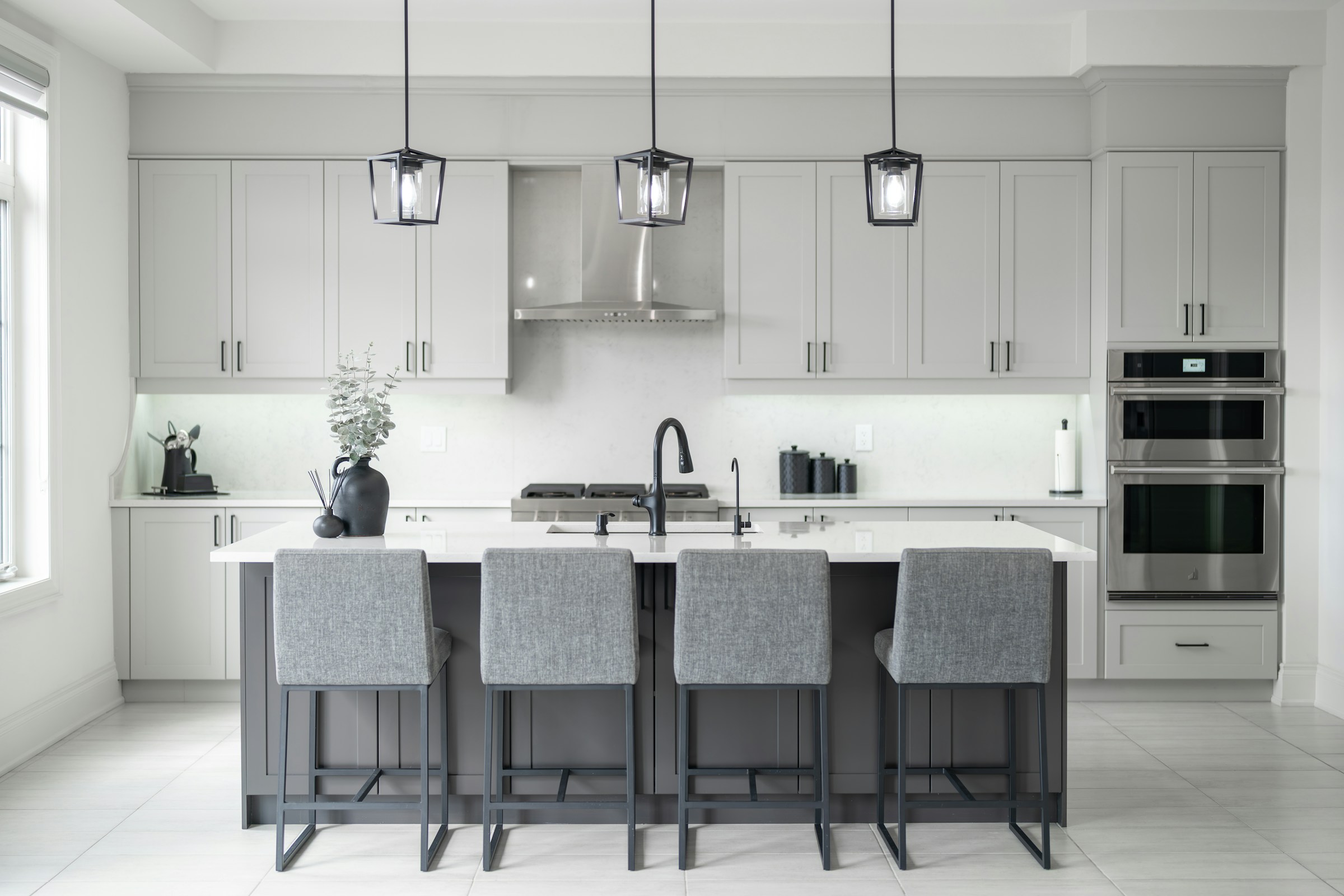
Quartz can be found in solid whites, soft grays, warm neutrals and patterns that echo natural marble. Because manufacturers control the color, matching a design across a long run of counters, an island and a backsplash is usually simpler. The page on kitchen countertop installation explains how those pieces are measured, cut and fitted so that patterns line up where they should.
Light matters as well. Kitchens in this region often have large windows and strong daylight, and some surfaces look very different at noon and at night. Always view the exact slab or a large sample near the light it will live in, because small chips can mislead. If your kitchen is dark, our page on dark kitchens and living rooms offers ideas that pair well with a lighter surface.
Everyday upkeep and stain behavior
Both materials are durable in everyday use, but they ask different things of you. Granite is porous to a degree, which is why it is commonly sealed. A sealer helps resist absorption of oils, wine and other liquids, and the sealed surface may need attention again from time to time. Ask the fabricator or supplier how often resealing is advised for the specific stone you choose, since stones differ.
Quartz is generally treated as non porous because the resin fills the spaces between the particles, so it usually does not need sealing. Spills tend to wipe off more easily. That does not make it indestructible, though. Harsh chemicals, abrasive pads and sustained exposure to certain products can dull or mark the surface, and manufacturers publish their own care instructions that you should follow.
Which one is easier depends on your habits. If you want the lowest maintenance routine and do not mind a more uniform appearance, quartz often fits. If you are comfortable with an occasional sealing task in return for a natural look, granite is a reasonable choice. Neither replaces common sense: wiping spills promptly, using cutting boards and avoiding strong cleaners protects either surface for a long time.
Humidity and salt air play a small role here. A coastal kitchen with open windows sees more moisture and more residue in the air, which can leave a film on any hard surface. Regular gentle cleaning handles that. What you want to avoid is a cleaning product the manufacturer does not recommend, because some polishes build up a haze and some acids etch natural stone. When in doubt, ask the fabricator for a written care sheet and keep it in a kitchen drawer.
- Granite is usually sealed and may need that step repeated, depending on the stone.
- Quartz is generally non porous and does not usually need sealing.
- Both surfaces benefit from prompt wiping of spills and the use of cutting boards.
- Always follow the care instructions from the supplier or fabricator for your specific slab.
Heat, impact and daily abuse
Cooks often ask whether they can set a hot pan on the counter. Granite handles heat well in general, since it is natural stone that formed under extreme conditions, but sudden temperature shocks can still stress any stone. Quartz contains resin, which can be sensitive to high heat, so trivets and hot pads are widely recommended. The sensible habit for either material is to use a trivet and avoid placing very hot cookware straight from the burner onto the surface.
Impact is another consideration. Both materials resist everyday bumps, but corners and edges are the weak points. A dropped heavy pot can chip an edge on either one. Granite chips can sometimes be repaired by a fabricator, and quartz chips can also be repaired in many cases, though a perfect color match depends on the material. An eased or rounded edge profile reduces the chance of chipping, as described in our guide to countertop edges and seams.
Think also about how your household really behaves. A home where children do homework at the island, where baking happens daily or where the counter doubles as a work surface will test the material differently from a kitchen used mostly for light meals. Be honest about this with your contractor. A material that fits your habits will look better after years than one chosen only for its appearance in a showroom.
Sunlight is a quieter test. Some engineered surfaces are intended for indoor use and can change color if they sit in strong direct sun for long periods, while natural stone generally tolerates light well. If your kitchen has a big sunny window or opens to a patio through a glass door, mention it, and ask the supplier whether the product you like is suited to that exposure. It is a small question that avoids an unpleasant surprise later.
Seams, slabs and how installation differs
Both materials come as large slabs that are cut to fit your layout. The fabricator measures, plans the cuts, polishes edges and makes openings for the sink and cooktop. Where the layout is longer than a single slab, seams are needed, and their placement is a design decision. A careful plan puts seams where they are least visible and well supported, often near the sink or at a natural break. Our guide on countertop edges and seams covers this in detail.
Granite's natural pattern means that adjacent pieces may not match perfectly at a seam, so a good fabricator lays out the pieces to follow the veining. Quartz patterns are more repeatable, but some bold designs have directional movement that must be lined up. In either case, ask to see the layout of the slabs and where each seam falls before cutting begins. Changing a seam on paper costs nothing, while changing it on the cabinet is impossible.
Weight and support matter too. Both materials are heavy, and cabinets must be solid, level and well fastened. Overhangs at an island or peninsula need support planning. If you are thinking about a bigger island, our service page on kitchen islands and peninsulas explains how seating overhangs and structure are considered together. Existing cabinets that sag or pull away should be addressed before stone goes on top.
Finally, think about waterfall edges, thick mitered edges and other dramatic details. They look striking, but they involve extra cutting, joining and support, and they raise the number of visible joints. If you want one, ask the fabricator to show you a drawing of how the pieces will be cut from the slab so you can see where the pattern will turn the corner. A clear drawing at this stage prevents disappointment when the stone is already cut.
Templating, lead times and planning order
Countertop installation follows a sequence. After the cabinets are installed and level, a template or digital measurement is taken so the fabricator can cut slabs to the exact space. Only then is the stone cut and finished, and installation follows. Because the template depends on the cabinets and sometimes on the sink and cooktop, you usually cannot finalize it until those selections are made.
This is why timing deserves a question, not an assumption. Lead times vary by material, supplier and the time of year, and the safest approach is to ask your contractor what they know about availability for the exact slab you want and to get that in writing. Our guide on lead times and ordering explains what to ask and how to avoid delays caused by late decisions.
Plan the plumbing and appliance choices before templating. A sink bowl style, a faucet with a specific hole count, and a cooktop model all determine cutouts. If you change your mind after the stone is cut, the countertop may need to be remade. The page on the kitchen selections checklist gives a practical order for making those decisions so that nothing is left to chance.
Also remember the old countertop. Removing it can disturb the backsplash, the plumbing connections and the wall finish behind it. Your written scope should say who disconnects and reconnects the sink and any appliances, who repairs the wall where the old top came off and who disposes of the material. Plumbing and electrical connections are handled by the appropriate trade under the contractor's coordination. Settling these points in advance keeps the installation day short and calm.
Backsplashes, edges and the finishing details
The countertop does not stand alone. Its edge profile, thickness, backsplash height and the way it meets the wall all contribute to the finished look. A full height backsplash of the same material creates a seamless, modern look, while a tile backsplash adds color and texture. If you are considering tile, read about kitchen backsplash installation and think about how the two materials will sit together.
Both quartz and granite can be paired with a wide variety of cabinet styles. White and light cabinets sit comfortably with either. Darker cabinets often look striking with a lighter counter, and a patterned top can balance a plain cabinet door. Our guide on choosing kitchen cabinets helps you consider the pieces together, rather than selecting each one in isolation.
Do not overlook the sink. An undermount sink makes the counter edge visible and requires careful cutting and polishing, while a drop in style sits over the surface. The choice affects how crumbs sweep into the sink and how the edge wears over time. Ask the fabricator to explain the edge finish around the sink cutout, since that area sees the most water and use.
Which household suits which material
Choose granite when you want a natural, individual surface and are comfortable with periodic sealing as your care routine. It suits cooks who value the heat tolerance of stone, owners who like to select a specific slab by eye and kitchens where traditional or earthy character is the goal. Remember that variation is part of the appeal, so it is worth seeing the exact slab in person.
Choose quartz when you want predictability, a consistent pattern and less routine maintenance, and when a particular color or marble look is central to your design. It suits households who prefer a calm, even surface, who want a clean modern appearance and who are willing to use trivets as a habit. Check the care instructions and the supplier's guidance on heat and cleaning products for the specific line you pick.
Consider other options too. Laminate and solid surface products suit certain budgets and styles, and our comparison of laminate versus solid surface counters covers those. If you are planning a larger project, the kitchen remodeling page explains how countertops fit into the overall sequence. Whatever you choose, put the exact material, edge, seam layout and backsplash in the written scope.
How to decide and what to ask before you sign
Start with three questions. How do you cook and clean? How much maintenance do you want? What look do you want to see for the next decade? Your answers will usually point toward one material, and a showroom visit will confirm it. Bring a cabinet door sample and flooring sample so that you judge the countertop in context rather than alone.
At the walkthrough, ask the contractor to describe in writing who measures, who fabricates, who installs, how seams are handled, how the sink and cooktop cutouts are done and how the site is protected. Every project begins with a walkthrough and a written scope, and a fixed price is set against that scope before work begins. If something unexpected appears when the old counter comes off, such as damaged cabinet backing, the work pauses and a written change order with a price comes to you first.
Finally, ask about what happens at the end. The punch list is walked together before final payment, so you can check seams, edges, caulk lines and cutouts in good light. Run your hand along every edge and look at the surface from several angles. The goal is a countertop that you still enjoy using long after the novelty of a new kitchen has passed.
Common questions
Is quartz or granite easier to maintain?
Quartz is generally non porous and usually does not need sealing, so many people find it simpler to maintain. Granite is natural stone that is commonly sealed and may need that step repeated. Either surface does well with prompt wiping, cutting boards and gentle cleaners recommended by the supplier.
Can I set hot pans on quartz or granite?
Granite handles heat well in general, while quartz contains resin that can be sensitive to high heat. The wise habit for both is to use a trivet or hot pad instead of placing cookware straight from the burner onto the counter. Ask your supplier for the heat guidance on the exact product you select.
Will two slabs of granite match each other?
Not exactly, because natural stone varies. A skilled fabricator lays out pieces so veining flows across seams as naturally as possible. Ask to see the slab layout before cutting, and view the actual slabs, not just a small sample, since color and pattern can differ from one slab to another.
Do both materials need seams?
Both come as large slabs, so a long run or an island may need one or more seams. Placement is a design choice that a fabricator should explain before cutting. Seams are often positioned near the sink or at natural breaks, and good support underneath keeps them tight and level.
How long will the countertop take to arrive?
That depends on the material, the supplier and the schedule, so ask rather than assume. Your contractor can find out about availability for the slab you want and tell you in writing. Decisions about the sink, cooktop and cabinets also affect the timing, so settle those early.
What should be in the written scope for a countertop?
It should name the material and slab, the edge profile, the seam layout, the backsplash, the sink and cooktop cutouts, the removal of the old surface and the cleanup. It should also say what is not included. A fixed price is then set against that scope before any work begins.